Now that nearly everyone carries a smartphone, QR codes are becoming an increasingly popular marketing tool. Savvy consumers often scan QR codes in the store before deciding to purchase an item. This makes them an excellent tool for guiding potential customers toward the decision to purchase your product.
What Are QR Codes?
QR is short for “quick response.” These are small, square, two-dimensional barcodes, which can be read by traditional barcode scanners and by smartphone apps. Today, nearly every smartphone has an app that will scan QR Codes, read hyperlinks, and bring the user directly to any web location you choose.
Including a QR code on your product label can turn your packaging into a dynamic, flexible, perpetual marketing tool. The code can point to a web page you can update as often as you’d like, effectively providing your current and potential customers with whatever information you wish them to have. The possibilities are as limitless as the Internet itself. You can link the code to anything you like, including:
Customer review sites such as Yelp or Google
Online magazine article or review featuring your product
Food pairing suggestions
Any page you like (or a new page you set up for this purpose) on your existing website
Your QR Code is Free!
The best part? The code costs literally nothing. Unlike UPC symbols, which can become costly, you can generate a unique QRC at no expense using free tools available online. If you prefer, we’d happily create one for you based on the URL you provide.
Including your QRC on a new label design adds nothing to the cost of your product labels, meaning you can take advantage of this technology at no expense. We can add a QR code to an existing digital label at no charge as well. For labels printed on a conventional press, there’s a small fee for setting up a new printing plate, just like any other change in label design.
QR Codes on Food Labels
By including a QRC on your custom food or beverage label, you can give your customers—and potential customers who may be standing in a store considering what product to purchase—an array of rich online content. This could include:
Online coupons or other promotions
Seasonal or monthly recipes
Contact information
Imagine having the opportunity to provide a wealth of valuable information and gently persuasive marketing copy in a square inch of space in the corner of your custom food label. It’s easy to see why QR codes are becoming increasingly popular not just with marketers, but with consumers as well.
QR Codes for Personal Care Labels
Portland loves its small-batch, eco-friendly personal care products. Green cosmetics and other health and beauty products face particularly stiff competition in the Pacific Northwest. With all the green skincare lines and other natural personal care products competing for shelf space, it’s a safe bet that many of your potential customers pick up several products and read the labels before making a purchase decision. With a QR code, you can send any smartphone user to read testimonials, view videos or see a list of complimentary products in your line—right there in the store.
Private Label Beer, Wine or Spirits
Do you provide private label libations for weddings and other special events? How’s this for a value-added service? Include a QR code that can point to:
A slide show for attendees to discuss
A YouTube video of a newlywed couple thanking wedding guests for attending
A web page that updates for annual or other repeating events
Literally any Internet content the event host desires
Rose City Label Can Help
QR codes on your custom product labels are an easy, convenient means of bringing consumers to the website of your choosing. They are becoming more widely recognized and popular every day. Many consumers, once they discover them, scan nearly every code they see in a store. A single, static code offers unlimited marketing opportunities, as you can update the page it leads to as often as you care to. Can you afford not to employ this emerging, increasingly popular marketing tool? Talk to us today about including a QR code as part of every label in your product line.
Recently, one of our clients came to us asking for the glossiest finish possible for their gourmet food labels. After looking through some samples of our previous work, they still wanted something with a bit more shiny gloss to it than anything we’d produced in the past. This company sought the most brilliantly reflective, wet-look labels available; and we agreed that such a label would really set them apart from competing products.
But how to accomplish this goal?
We already have multiple ways to provide our customers with a varnished, glossy product label. Could we improve on that? Could we make it … shinier? Could we set up the design, and then somehow add a deeper, gleaming shine to the finished run? At Rose City Label, we relish a challenge such as this one.
Experimenting With Label Finishes
For many of our current labels, from food and beverage to personal products, we already use a clear coat—rather like a varnish—as the final step in label printing. This liquid coating is then cured under a powerful UV light. This seemed like a good place to start.
Could the solution to this challenge be as simple as using a heavier dose of clear coat for this client’s food labels? That presented a problem. Too much, and the UV light won’t penetrate deeply enough into the coating. This would result in a tacky, unfinished surface. Still, it seemed to be the best place to begin.
We ended up adjusting the printing press to deliver just the right amount of clear coat to obtain a deep, polished gleam without applying a heavier coat than the UV light can penetrate. It took some trial and error, but we found just the right amount of clear gloss to overlay onto the printed labels for an intense shine, fully cured and smooth to the touch.
Do You Have a Labeling Challenge?
For most labeling challenges, we may already have the ideal solution to provide custom product labels you—and your customers—will love. Your business faces enough trials on a daily basis. Let us handle the responsibility of providing the look and feel you desire for your custom product labels. We’ll find just the right process to deliver a high quality, consistent result.
Give us a call at 1-800-547-9920 or contact us online. We welcome the opportunity to provide the custom label solutions you seek for your product.
Your labels are important to you—and your customers. They’re often a customer’s first hands-on experience with your brand. Like the perfect clothing accessory, the perfect label sets off your product and gives it a polished, memorable look.
Here at Rose City Label, we understand how important this is to your business. We’re mindful of the fact that specific labeling needs often require different approaches to ensure the best possible result. We work hard to maintain a diverse portfolio of production options. This enables us to provide a consultative technique—we aren’t married to any one solution, except the one that is best for your particular label needs.
Our label printing technicians, with an average tenure of over 12 years each, comprise the most experienced production team in the Northwest. We pride ourselves on the ability to recommend the label printing solution that’s best suited to your product and to the project at hand.
Rose City Label has recently invested in digital printing equipment. This modern label technology is our fastest-growing department, and for some labeling needs, it really shines. However, it may not be right for every project. Depending on your needs, conventional printing may still be the best option.
We’d welcome the opportunity to help you determine whether traditional or digital label printing methods would best suit your needs, but considering a few factors should give you a good idea whether digital printing is ideal for you.
Short Label Run or Long?
Digital printing is ideally suited to a short label run. Run length refers to the linear footage of label stock running through a printing press. This will vary depending on the size of each label as well as the number of labels desired. The shorter setup on a digital press makes it an attractive option, both financially and environmentally.
For simplicity, we can advise that a run of around 3,000 feet or less may be a good candidate for this modern label technology. This can vary slightly depending upon the size of each label. Run length is not the only determining factor in deciding which technology to use, but it’s a good place to start.
Static or Variable Label Data?
Multiple versions of a label, such as different color combinations with the same print data, can often be done on a traditional press. However, making such a shift is usually easier—and more cost-effective—on a digital press.
Changing Data? Go Digital
This is perhaps the easiest consideration. If you need variable data, you need digital labeling. Dynamic data elements require that the job be printed on a digital press. Printing variable data such as serial numbers, fluctuating barcodes or numbered limited editions on a conventional press would most likely be cost prohibitive.
Trusted, Unchanging Label Designs
If your label design is mature, stable and unlikely to change, conventional printing methods may be more suited to your project. If your runs are medium to long length and your design is static, traditional printing technology may be the wiser choice. Once the initial plates and setup are in place, they can be used repeatedly on the conventional press without additional charge. For such a project, conventional print methods are likely to be less expensive than digital in the end.
Type of Stock Desired
If you desire an uncoated, textured label stock, digital printing has a clear advantage. Our HP Indigo digital offset press produces an exceptional result on uncoated stocks. The print quality and resolution is slightly better on the digital press. On some types of stock, the difference isn’t apparent. On others, it can be quite noticeable.
Metallic Inks, Die Cutting and Other Conversions
Perhaps digital label printing’s biggest weakness is that it doesn’t allow many options when it comes to converting. Converting refers to everything we do to produce a label, aside from putting ink on paper.
• Complex die cutting
• Back slitting
• Top scoring
• Perforations between labels
Options such as these are not available with digital label printing.
Additionally, digital runs produce labels in rolls as opposed to sheets. If you require certain conversions or need labels delivered in sheets, you’ll need to choose the traditional press for your project. Another popular feature—metallic ink—is not available when using the digital press.
When is Digital Label Printing Your Best Option?
There are many factors to consider when deciding which press to choose for your project. If you need variable data, digital is the clear (and only) choice. Other elements that may lead you to choose digital label printing would include:
• Short label run
• Uncoated stock
• Desire for very fine quality at high resolution
• Graphic design that is still evolving or may change periodically
• You can work with a roll rather than individual sheets
If your project has any of the above qualities, no special converting and you can live without metallic inks, digital printing will deliver an impressive result.
What’s more, digital gives us the ability to produce very low cost press proofs—printed samples on your actual label stock. These can be ideal for prototypes, photo shoots, and presentations to investors.
It’s important to note that not all modern label technology is necessarily digital. Our conventional presses, just like our shiny new digital equipment, are state-of-the-art, high quality machines which produce sharp, crisp labels of the highest caliber. By working Rose City Label, you give yourself access to experienced professional support and an array of printing options.
Ready to discuss how Rose City Label can help you set your product apart from your competitors? Give us a call at 503-777-4711 or send us an email. We’ll guide you through the choices and help you select the best option for your labeling needs.
Nobody likes a hard project – we all prefer EASY. Luckily there are a handful of proven, easy ways to improve your labels. These are low cost strategies to make sure you get the very best outcome with your next label project – all they require is a little planning and thought. And, once you adopt these strategies, they can be applied to ALL your future label projects – they will all benefit from these 6 easy tips.
1.Market – Who are We Selling To?
Your target audience is the first thing you want to consider when you are creating a new product. This applies to the product itself, as well as the label, the website, the sales channel, and may other aspects of your business. The customer is the reason for your product’s existence. Take the time to define, narrow, and validate the ideal customer you are targeting. Based on that, your label design will follow – are you upscale and corporate? Small batch organic? Hand made or mass produced? Sold online or at Farmer’s markets? All of these questions must be answered to get the best possible label for your product.
2.Begin with the End in Mind (is it a bag, box, or bottle?)
Now that the market is defined, and assuming your product is fully developed, start thinking about the package itself. Will you sell in brown glass, clear glass, plastic bags, or corrugated boxes? The container, and the size of the container, have a huge impact on what type of label will work best. Durability is also a key question here- are the products used outdoors? Are they shipped long distance? What is the expected useful life of your product – a 2 gallon warehouse store package is much different than a single serve bottle. Consider what the label is applied to, and how long it needs to last, as early in the conversation as possible.
3.How Will They Get on the Container?
With the brand, the product, and the package nailed down, think about the physical production of the product. Are you using a contract packager? A mobile bottler? Or are you making it in small batches at home. (And if you are making it at home, where to you want it to scale to?). All these questions are critical, because they determine how the labels must dispense. Nearly all the labels we produce are on rolls – but what orientation on the roll (right edge off first, bottom off first) and the roll size and core size can be major stumbling blocks if they aren’t addressed up front. We can accommodate almost anything, but we need to know about it early in the process. Think through this decision as early as possible – even if you are just deciding how you will set up your home kitchen to label Mama’s famous spaghetti sauce.
4.Quantity and Variety
How much of your amazing sauce do you expect to sell? We recommend buying a 6-12 month supply – this will give you a good volume price discount, but won’t burden you with excess cash tied up in inventory. The more you buy of a given label – the lower the cost per piece – that is pretty obvious, but it has to be balanced with the risk of a product revision. Obsolete labels are worthless and a bad decision, no matter what price break you got – it doesn’t matter when they are in the garbage can. Also, what about differe3nt flavors? Sizes? or other product variations… If you can group multiple products together, with the same label size, you can get great economies of scale. This ‘bulk order’ could include multiple versions of the same label – this is a great way to test market – or it could include multiple distinct products – spicy, medium, and mild for example.
5.Budget
The other way to arrive at quantity and variety is to establish a budget. This is especially useful if you have a new product with no sales history. How much have you set aside for labels? If that is $500, or $1,000 or whatever it is, we can help you back into the best strategy to get the most label value for your fixed investment dollars available. This is especially true if you have answered the other questions in this article- armed with that information, it is easy to decide the best label choice for your product. This can also be approached from the ‘cost per label’ budget perspective. If your product cost (and sale price and profit) have to come in at a certain level, we can figure out how many labels you will have to purchase to hit that unit cost – this may also influence the design and complexity of the label if we are shooting for a certain price point
6.Future Expansion of the Product Line
Usually the first step is just getting your first order placed – or moving over to a vendor that understands your needs – and getting the project off the ground. BUT – it makes sense to think about the long term as early as possible. Where do you want to be? What is the expansion strategy? If all goes well, where do you want to be in 5 years? How many products? Sold in what locations? Think about this and how it may affect your label design. We have to focus on the ‘now’ but we can’t ignore the big picture.
NOTHING About Label Equipment or Technology!
Notice that none of the steps here have anything to do with ink, paper, foil, or die cutting. Those are very important, and we live those every day, but they aren’t the right place to start. We offer a full like of label printing – from simple to complex, and from small to large runs. We have ALL the tools, but we need to have these questions answered first before we can recommend a specific technology solution. Don’t worry about size, shape, or price until you have a clear idea of where you are going. Use these steps to chart your course, and you will be successful. In a future post I will discuss the next steps = applying the specific label production methods to solve specific problems – but first you need to clearly define the problem. With that, you are half way to the solution.
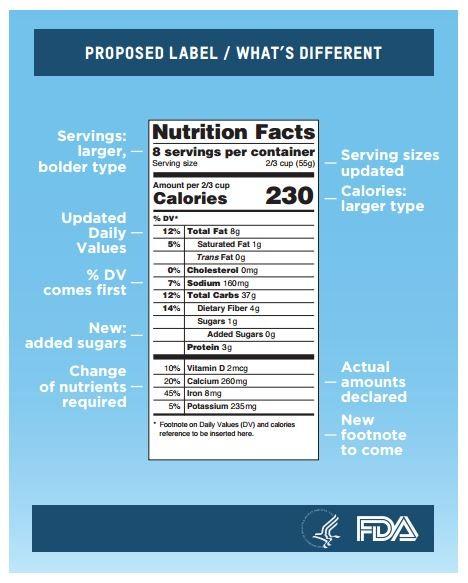
Changes are coming to the Nutrition Facts panel. We serve many different industries at Rose City Label and we are always trying to keep up with the latest trends in labels – both regulatory and design.
The FDA remains on track to update its nutritional labeling for individual food and beverage packaging. We anticipate the final version will be issued the first quarter of 2016, and that industry will need to come into compliance by January 1, 2018.
The most current version of the new label is here – please take note of these changes. They will affect all food label customers that are required to show Nutrition Facts on their labels.
What does this mean for you?
Partnering with a knowledgeable, experience printer is more important that ever
Many people will be changing their labels, so responsive service will be key
Plan for the change – there will be costs associated with this change, so please plan accordingly
Take the opportunity to review your graphics at the same time – does your label need a face lift?
Don’t know where to begin? Call us today – we can help.
Thank you for trusting Rose City Label with your label projects – we appreciate the faith and confidence you place in our team every day.