by admin | Mar 11, 2016 | Beer Wine Spirits
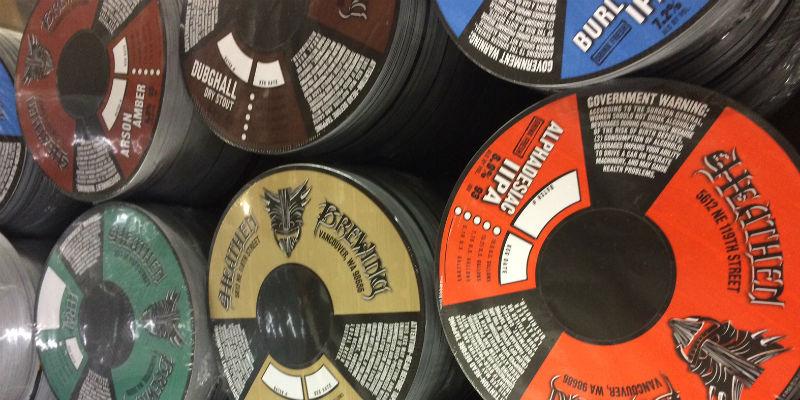
Although most of our beer and wine clients come to us for adhesive labels for their bottles, we can also print custom Keg Collars as well. Keg collar printing is something we do very well at Rose City Label. Here is why you should consider us for these products.
- We know great quality printing. Our craftsmanship and attention to detail will reinforce all other elements of your branding. Having a poor quality keg collar sends a message to your customers that you don’t care about quality – and they could easily assume that extends to the quality of the beer IN the keg. Don’t build doubt – focus on quality.
- We have your graphics anyway! If we are already printing your bottle labels, we know your brand, your colors, and your logo.
- Simplify your life – one less vendor to work with is helpful for anyone.
- You are required by law – you know you have to have keg collars, so the only question is where to buy. We can help with the perfect balance of quality, price, and fast delivery.
If it is printed, and a brewery needs it to build their brand, we can probably help.
Call us for your bottle labels, tap handle labels, promotional stickers, and keg collars.
by admin | Feb 10, 2016 | Beer Wine Spirits, Customers/Examples, Technical
Customer behavior testing can help us design better wine labels. Really.
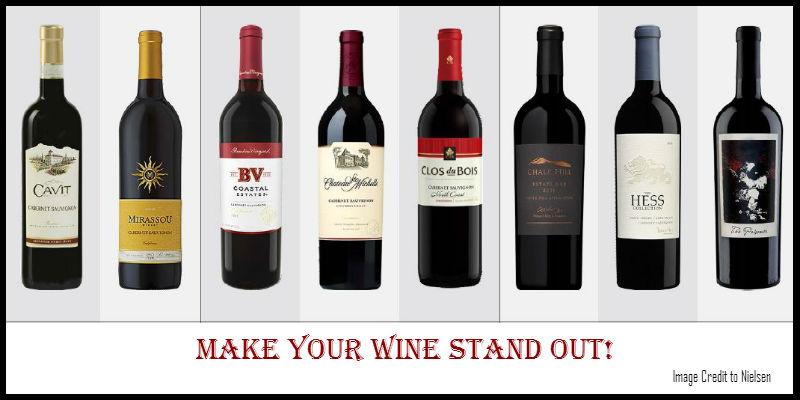
Wine label design is very personal – every wine brand has a unique story to tell. Often, this has meant that everyone was designing by the ‘seat of their pants’ with no science behind the decisions and no validation of what works. Now, thanks to a December 2015 report by Nielsen, we have actual customer data to give us insight into what catches the eye (*and perhaps, why). This great research paper has comments and insights from individuals, but also scientific data that shows where the human eye goes on the shelf, and how long it stays there. This behavior can change over time, so this study will be repeated in the future, but for now, this data is a golden opportunity to put some science behind the highly emotional process of wine label design.
Click here to download the 15 page PDF for the entire report.
As we have written before in this post, your labels must be authentic and reflect your true brand values, culture, and be consistent with other parts of your messaging. Don’t just make a massive switch to your label design based on this report – it won’t work.
Instead, take these insights and incorporate them into the overall conversation about your positioning and branding in the market.
Here are the key points:
- In addition to gabbing consumers’ attention, the label must also convey certain key messages, points of differentiation from competition, and a distinct personality.
- 64% of consumers will try a product because the package catches their eye. 41% will continue to buy a product because they like the packaging.
- The wine category is crowded. 4,200 new wines were introduced in 2014.
- Consumers make most decisions at the retail shelf – the category is fragmented with little brand loyalty.
- Media spending is low relative to other commodities, so shelf appeal is even more important.
- Package design can also help gain distribution – labels appeal to restaurant owners and wholesale distributors too.
Additional key findings:
- To stand out, be colorful and contrarian. The most visible bottles are seen by up to 77% more consumers than less visible ones, according to eye tracking measures.
- Distinct personalities drive engagement. Lower price points tend to succeed with casual, fun themes. Higher price points have more uniform design.
- Millennials favor bold and breezy. This is particularly true on the lower price points, but also on higher tiers. Younger buyers value tradition less.
- There are unclaimed areas in the market. Despite saturation of product, there are open areas to fill. See page 8 of the report for full details.
- Images attract attention, but not always positive. Be careful if your central graphic is controversial – the attention may backfire with some consumers.
- Colors, shape, typeface, and images make the label. These are the key elements that define a label – use them to your advantage.
The wonderful news for winery brand owners of all sizes is that all these design elements are available to almost everyone now.
The power of digital printing technology has leveled the playing field and allowed brands of all sizes to have a fair shot at gaining the consumers’ attention and winning at the retail shelf. Thank you for trusting Rose City Label with your project.
Please call us today and we will help you translate this research into a winning label that aligns with your authentic brand and builds a deeper connection with your consumers.
Cheers!

by admin | Jan 21, 2016 | Beer Wine Spirits, Business Tips, Food Beverage, Label News
Nobody likes a hard project – we all prefer EASY. Luckily there are a handful of proven, easy ways to improve your labels. These are low cost strategies to make sure you get the very best outcome with your next label project – all they require is a little planning and thought. And, once you adopt these strategies, they can be applied to ALL your future label projects – they will all benefit from these 6 easy tips.
1.Market – Who are We Selling To?
Your target audience is the first thing you want to consider when you are creating a new product. This applies to the product itself, as well as the label, the website, the sales channel, and may other aspects of your business. The customer is the reason for your product’s existence. Take the time to define, narrow, and validate the ideal customer you are targeting. Based on that, your label design will follow – are you upscale and corporate? Small batch organic? Hand made or mass produced? Sold online or at Farmer’s markets? All of these questions must be answered to get the best possible label for your product.
2.Begin with the End in Mind (is it a bag, box, or bottle?)
Now that the market is defined, and assuming your product is fully developed, start thinking about the package itself. Will you sell in brown glass, clear glass, plastic bags, or corrugated boxes? The container, and the size of the container, have a huge impact on what type of label will work best. Durability is also a key question here- are the products used outdoors? Are they shipped long distance? What is the expected useful life of your product – a 2 gallon warehouse store package is much different than a single serve bottle. Consider what the label is applied to, and how long it needs to last, as early in the conversation as possible.
3.How Will They Get on the Container?
With the brand, the product, and the package nailed down, think about the physical production of the product. Are you using a contract packager? A mobile bottler? Or are you making it in small batches at home. (And if you are making it at home, where to you want it to scale to?). All these questions are critical, because they determine how the labels must dispense. Nearly all the labels we produce are on rolls – but what orientation on the roll (right edge off first, bottom off first) and the roll size and core size can be major stumbling blocks if they aren’t addressed up front. We can accommodate almost anything, but we need to know about it early in the process. Think through this decision as early as possible – even if you are just deciding how you will set up your home kitchen to label Mama’s famous spaghetti sauce.
4.Quantity and Variety
How much of your amazing sauce do you expect to sell? We recommend buying a 6-12 month supply – this will give you a good volume price discount, but won’t burden you with excess cash tied up in inventory. The more you buy of a given label – the lower the cost per piece – that is pretty obvious, but it has to be balanced with the risk of a product revision. Obsolete labels are worthless and a bad decision, no matter what price break you got – it doesn’t matter when they are in the garbage can. Also, what about differe3nt flavors? Sizes? or other product variations… If you can group multiple products together, with the same label size, you can get great economies of scale. This ‘bulk order’ could include multiple versions of the same label – this is a great way to test market – or it could include multiple distinct products – spicy, medium, and mild for example.
5.Budget
The other way to arrive at quantity and variety is to establish a budget. This is especially useful if you have a new product with no sales history. How much have you set aside for labels? If that is $500, or $1,000 or whatever it is, we can help you back into the best strategy to get the most label value for your fixed investment dollars available. This is especially true if you have answered the other questions in this article- armed with that information, it is easy to decide the best label choice for your product. This can also be approached from the ‘cost per label’ budget perspective. If your product cost (and sale price and profit) have to come in at a certain level, we can figure out how many labels you will have to purchase to hit that unit cost – this may also influence the design and complexity of the label if we are shooting for a certain price point
6.Future Expansion of the Product Line
Usually the first step is just getting your first order placed – or moving over to a vendor that understands your needs – and getting the project off the ground. BUT – it makes sense to think about the long term as early as possible. Where do you want to be? What is the expansion strategy? If all goes well, where do you want to be in 5 years? How many products? Sold in what locations? Think about this and how it may affect your label design. We have to focus on the ‘now’ but we can’t ignore the big picture.
NOTHING About Label Equipment or Technology!
Notice that none of the steps here have anything to do with ink, paper, foil, or die cutting. Those are very important, and we live those every day, but they aren’t the right place to start. We offer a full like of label printing – from simple to complex, and from small to large runs. We have ALL the tools, but we need to have these questions answered first before we can recommend a specific technology solution. Don’t worry about size, shape, or price until you have a clear idea of where you are going. Use these steps to chart your course, and you will be successful. In a future post I will discuss the next steps = applying the specific label production methods to solve specific problems – but first you need to clearly define the problem. With that, you are half way to the solution.

by admin | Jan 13, 2016 | Beer Wine Spirits
At Rose City Label, we always try to surround ourselves with industry leaders. We work with many customers that have their own in-house bottling equipment, and many beer and wine companies that use outstanding mobile bottlers and canners, but we seem to be doing more and more business with Craft Canning here in Portland.
Craft Canning is a rapidly growing company in East Portland that provides mobile canning and bottling services to beer and cider companies. They also sell, service, and install canning lines for people that want to bring the equipment in house.
This week the people from Craft came to Rose City Label for a tour – we want to make sure we understand the best way to partner so our ultimate end customer – the brewer or cider maker, gets exactly the right product on their bottle. By collaborating with leaders, we continue to make our business better and better.
To learn more about Craft Canning, visit their website by clicking here.
If we can help with labels – please give us a call today. We are busy, but we are always willing to slow down to help new customers.
by admin | Jan 8, 2016 | Beer Wine Spirits, Business Tips, Food Beverage
In Oregon, we love to root for the underdog. Rather than large corporate, we value local and support local business. That’s one reason why Oregon’s local micro brewing industry has done so well and the good news is the benefit of Oregon’s mindset doesn’t stop at beer.
Other small craft businesses can benefit from the support local mindset. One category which is enjoying growth is small, local food producers.
Celebrate Small – Don’t Hide It
When it comes to standing out of the shelf; Oregon is blessed with a thriving graphic design community, and vendors offer technology which allows today’s small producers to stand out on the shelf with eye-catching professional packaging that creates a bond between your consumer and your business. Oregon is in fact the perfect state to celebrate being small and to thrive while doing it.
It helps that you don’t need to be Goliath to have great label. Smaller companies are by their nature nimble, make changes more easily, and have adaptation and change built into their DNA. Smaller enterprises are often closer to the “local vibe” of the communities within which their products are sold. So, in terms of creating product and label design that resonates with your local market, being small can be a real advantage.
Your labels don’t have to look ‘small’
At Rose City Label, there’s nothing we love more than helping a smaller company fulfill their dreams. We take pride in every single label, knowing these labels are going to draw consumers in to pick up, and try your product and we’ve invested in the technology to print smaller runs cost effectively. It’s a real thrill to see these labels pop up in unexpected places as our client’s grow.
You don’t have to order millions for a good price
The best part of growing your business in Oregon, is that Oregon’s local vendors are experienced with working with smaller companies to help them succeed. At Rose City Label, we have increased our digital printing capabilities continuously over the last 5 years specifically to bring the cost of shorter print runs down, while increasing the flexibility we have to accommodate innovate design in shorter runs and maintain a great label you will be proud of.
It helps us be ready to help you – and we think that’s a great thing.
by admin | Dec 30, 2015 | Beer Wine Spirits
Oregon Craft Beer is still moving forward! The Oregon economy continues to grow and benefit from the Craft Beer industry. Senator Ron Wyden was in town last week for a private lunch with the beer industry – he is proud of the good work our brewers and suppliers are doing to grow this robust sector of the Oregon economy. Our quality, passion, and willingness to work together as an industry were all keys to our success, according to Wyden.
The Portland Business Journal recently published data from the Brewers Association – it is very interesting:
- Oregon Craft Beer production exceeded 1 BILLION Barrels in 2015 for the first time ever
- Production growth was 18% last year, following 2 years of 15% growth
- The economic impact of this industry is $449 per capita – making Oregon the highest in the nation
- Oregon Craft Brewery count is up to 216, up from 124 in 2011
All of this data points to one thing- Oregon Beer is ON FIRE! We are proud to supply many of these growing producers and we work hard to support them every day.
Please contact us today if we can help you. We look forward to serving you again in 2016. Cheers!
