This label project uses PLA, polylactic acid, as the label material. It’s made from corn, not petroleum and not trees. This label is a beautiful, long-life product, printed two colors, and laminated with a clear over laminate film.
Unlike many of our labels, this label doesn’t get delivered in rolls. It’s cut individually and handed out to consumers. At the end of the press here, the labels are cut into strips so a label can still be run, maximizing the press web for best economy.
This information is posted other places on our site, but it is so important I thought it needed to be reposted so blog readers could see it again. This is really the essence of who we are, and how we present ourselves in the market place. We don’t have a formal Mission Statement, but if we did, this would be the basic outline of it. While our pricing is always competitive, it isn’t always our goal to have the lowest label price – we would rather be the best overall value. Some industry experts call this the ‘Total Applied Cost’ of the label from design, material selection, ease of application, and follow up and support after the first order. This is who we are, and this is where we shine:
We are label experts. We will review your needs and find the very best products. We won’t oversell you.
We are excellent printers. We have great equipment and we know how to use it. Top quality since 1928.
We value all customers. New and old—large and small, we will take the time to make sure you are happy.
We are responsive. We provide quick, accurate quotes, timely status updates.
We protect the environment. As a County-certified BRAG green business, we are committed to Green.
We have stable ownership and team members. With more than 12 years average experience, we will be here.
We are flexible, hungry, and eager to serve. Rush orders are no problem—we do what it takes!
Call us today at 503-777-4711 to find out more. Thank you
This high quality label was designed by Rose City Label to help the customer protect their valuable software. The End User License Agreement (EULA) is clearly printed on the label that secures the DVD Case – if you open this case, you own the product.
Rose City Label designed a label that has an easy to use MicroPerforation – basically a zipper – designed into the label. The Mylar laminate is put into the center of the stock with narrow perforations. White, red, black ink are all applied, and then a clear lamination is applied to the label before it’s die-cut with a micro-perforation.
The label has two layers of clear poly label stock, plus a thin strip of bright silver mylar to provide strength and to help the user understand where to pull and peel in order to get into the package. This label has to keep the product closed, but also provide easy access for the end customer.
This label is run on two different presses – first, the bottom layer of poly is slit and the thin mylar ribbon is applied. Then, in this video, the prepared stock is run through a second press, printed 3 colors, laminated, with another layer of poly, and diecut.
All of this must be done in precise registration to make sure the product looks appealing and works for the end user. This product was designed 7 years ago and has been in service around the world for this international technology company ever since. This multi-layer, multi-press construction gives a finished label that is versatile, economical, and work. The tamper-evident seal allows the customer to know if a product has been opened and used.
Call us today if you have a challenging label project – 800-547-9920. Thank you.
After finishing the detailed process of designing a product’s custom label, some businesses may tend to rush the last steps to printing. However there are a lot of important considerations to make sure you’re choosing the label features that will work best for your product. One of these main considerations is the adhesive, because choosing the wrong adhesive could extremely hurt the presentation and shelf life of the product’s packaging.
When requesting removability for a label, we tend to ask lots of questions and then ask the customer to test recommendations for suitability in that particular application. There are many things to take into account to choose the right adhesive, here we will explain the main items to keep in mind.
Removability.
It’s hard to define this category, because there are certain products that are considered removable, however, this ability declines over time and if enough time has elapsed, then they permanently attach to the substrate. Masking tape is a good example in this case, which is easily removable for a few hours, but the longer it’s left on the surface the harder it is to peel off. Besides time, temperature and the quality of the meeting materials are important factors that are decisive of how removable the adhesive should be.
It is very important that you don’t mistake removability with repositionability, the latter meaning that the label can be repositioned on the packaging for 20 to 30 minutes, without damage being done. Only after the passing of this short period of time does it permanently adhere.
The key to helping your label supplier make a good recommendation for your removable label is to advise them of the substrate to which the label is being applied.
Temperature.
It’s very important to know what temperature the adhesive will be applied to the packaging, because under different circumstances different needs have to be met.
Service temperature is defined in a range where the adhesive can function properly after being applied, this is a fairly wide range from about -65º F to +200º F. (specialty products can go beyond these ranges) Minimum application temperature is the range of temperature when the adhesive can be affixed to the packaging. The adhesive is to some extent a liquid, therefore it needs to be able to flow. In cold temperatures (e.g. frozen goods) special adhesives are needed, because an ordinary one will freeze, which would reduce the adherence of the label. The first 24 hours are crucial, this is roughly the time interval when minimum application temperature affects an adhesive. “All temperature” adhesives are available, however due to its high price, you should only use it when specifically needed.
Quality.
Acrylic adhesives have high temperature and solvent resistance, however silicone adhesives have a higher resistance in both areas, but is more expensive. Choosing the best quality label for your budget will be taken into account during a consultation.
Keep these aspects in mind and choose an adhesive that fulfills your specific needs, from the never ending selection the industry has to offer. A conversation about the conditions the label will be subject to, including application temperature, service requirements, quality and your definition of removability, is a must!
We have talked at great length about the many benefits of digital printing – low waste, low to no setup time, and excellent print quality. So what then, is the best way to maximize the value of your job on the digital press? Answer – FILL THE WEB!
Everything in digital comes down to the linear inches (or feet) through the press. We don’t change our prices based on the complexity of the print — 1C is the same price is 4C printing. The determining factor is the linear distance required to complete the job.
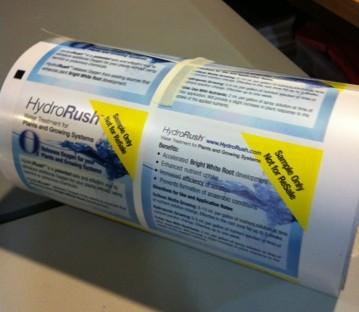
So, try to fill the 7.75″ print width the best you can. This great customer, Scott Sakamoto of Hydrorush asked about this and designed his front and back labels to fill the web. If he had made each label just 0.25″ wider, he would have paid twice as much for his printing!
Small changes make a big difference! Call us today so we can help you maximize your digital printing dollars.
FTP (file transfer protocol) is the best way to transfer large files to us. Many files are small enough to come to us as email attachments, and that works well too, but if your file has a very large full color image, or your email capacity is limited for some reason, FTP is the answer. FTP has been around for many years, so for some reason people think it is old fashioned, or hard to use, but that just isn’t the case! FTP is still in use today because it works. The only negative comment about FTP is that it truly is just a file transfer – it is like dropping a package on our back porch. Please send us an email after you make the transfer to let us know that the file has been submitted! We don’t go out and look on the back porch for packages every day, and we don’t always check the FTP server for new uploads every day, either.
We also use newer, web based services like DropBox, YouSendIt, or LeapFile, but the old fashioned FTP still works very well.
To use FTP, you need to download a free FTP client program – available for Windows or MAC. There are many available, these are two I have used in the past:
Filezilla – http://filezilla-project.org/
SmartFTP – http://www.smartftp.com/
Once the software is installed, you will put in this setup information to connect to our FTP server to transfer your files:
Please contact us for specific login information
** If you intend to transfer files often, we would also be happy to set up a private folder specifically for your company use.
As always, we encourage you to contact us at any time via email or phone if you have any questions.